glma software validation
The usage snippet shows the supported glma package calls.
These recorded simulation results assess selected behavior on ten fixed datasets from the shared design. They do not revalidate the statistical method or cover every setting. The use snippets show the current package interfaces. This report step summarizes retained artifacts and does not rerun analyses. The glma guide describes current inputs and options.
Use
linear <- glma::glma(y, Glist, method = "linear", threads = 1)
loco <- glma::glma(y, chromosome_Glist, method = "infinitesimal_loco",
             algorithm = "decoded_full",
             background_markers = seq(1, 50000, by = 100), threads = 2)
The LOCO records below predate the Gaussian joint engine now used by infinitesimal_loco. They qualify the earlier route only; they are not timings or calibration evidence for the replacement estimator.
Results
| Check | Observed result |
|---|---|
| Linear marker tests | 1,500,000 |
| Maximum selected OLS difference | 9.49e-15 |
| Median time, three linear scans | 352.0 seconds |
| LOCO tests with successful status (seed 2) | 50000/50000 |
| LOCO elapsed time (seed 2) | 38.0 seconds |
| LOCO calibration factor (seed 2) | 1.000 |
The linear checks compare selected markers with R ordinary least squares.
One-dataset illustration
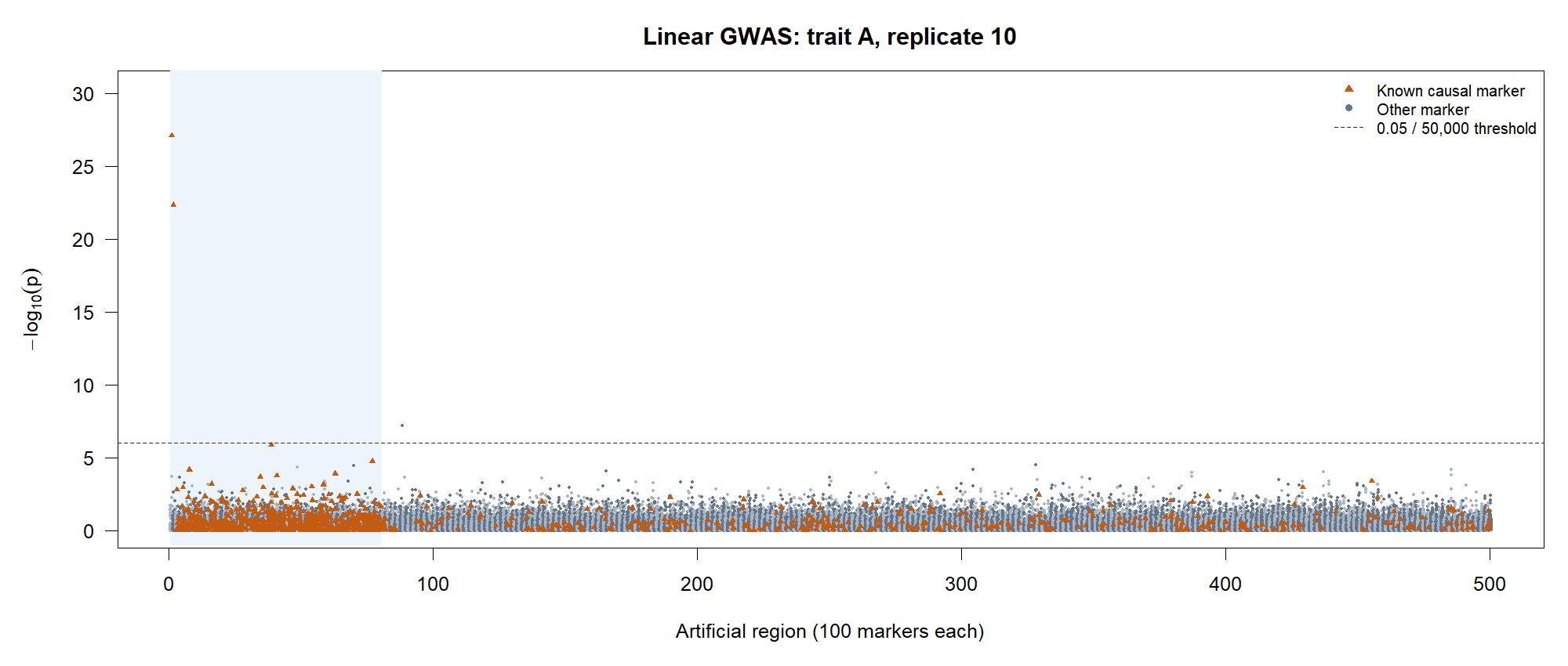
The Manhattan plot shows trait A in prescribed replicate 10. Orange triangles mark known causal markers; other markers can also give a signal through LD. The shaded first 80 regions have a higher simulated causal-marker frequency. The dashed line is the per-trait 0.05 / 50,000 threshold.
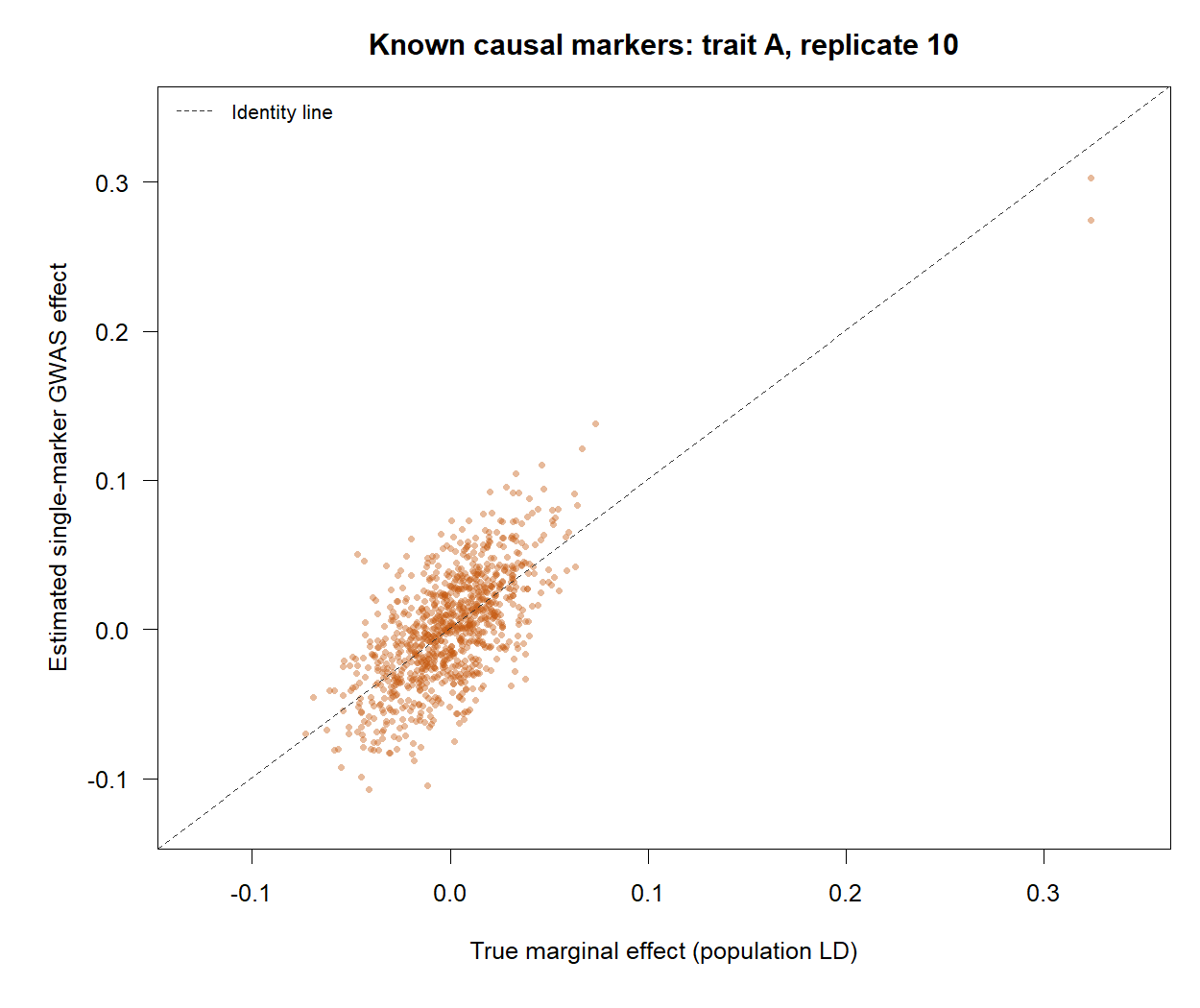
The effect plot compares estimated single-marker coefficients with their true marginal effects at the 935 known causal markers (correlation 0.689). The true marginal effect includes the known population LD around each direct generating effect. Across all 50,000 markers, mostly with near-zero true effects, sampling noise dominates (correlation 0.143).
LOCO timing check
The separate LOCO timing run uses the second simulated dataset, groups artificial regions into 20 chromosomes and fits a 500-marker background. LOCO was timed once, so repeatability was not assessed. This unrelated-individual design does not establish mixed-model null-tail calibration, parameter recovery or a benefit over ordinary regression.